

Why flexible portions make the difference in central kitchens and catering
Why do flexible portions make the difference in central kitchens and catering? More and more meals are no longer cooked where they are eaten, but prepared in one central kitchen and then distributed to restaurants, shops, schools or care facilities. That calls for more recipes, more portion formats and tighter planning than ever.
The challenge therefore shifts from the cooking kettle to the line that follows: how do you portion, close and transport thousands of meals a day, with consistent quality and as little manual work as possible?
More meals, more variants
The European ready meals market is worth around 90 billion euros and grows by about 5 percent a year. In Belgium, Foodmaker is a clear example of that scale-up. The company opened a 20,000 square metre central kitchen in Westerlo, an investment of 50 million euros. Today the site produces around 150,000 meals a day, with the aim of doubling that to 300,000. The range includes more than 200 products and some thirty trucks leave every day for restaurants and retail partners in five countries.
At the same time, margins are under pressure. Food service wholesaler Sligro gained market share in the Netherlands and Belgium in the first half of 2026, but saw its profitability fall sharply due to cautious consumers. For central kitchens and caterers, that means growing in volume and variety without the cost per portion growing along with it.
From kettle to trolley: where the line loses time
For soups, sauces, stocks and stews, most of the time is often not spent on cooking itself, but on everything that comes after it. A good line analysis therefore starts with questions such as:
- How many different portion sizes must the line be able to deliver, and how often is the format changed?
- Is the product filled hot (Cook & Chill) or filled cold and then pasteurised in the pack?
- How many handling steps are needed between filling, closing, hanging and loading?
- How long must the product keep before it reaches the customer?
What clip-pak® changes in practice
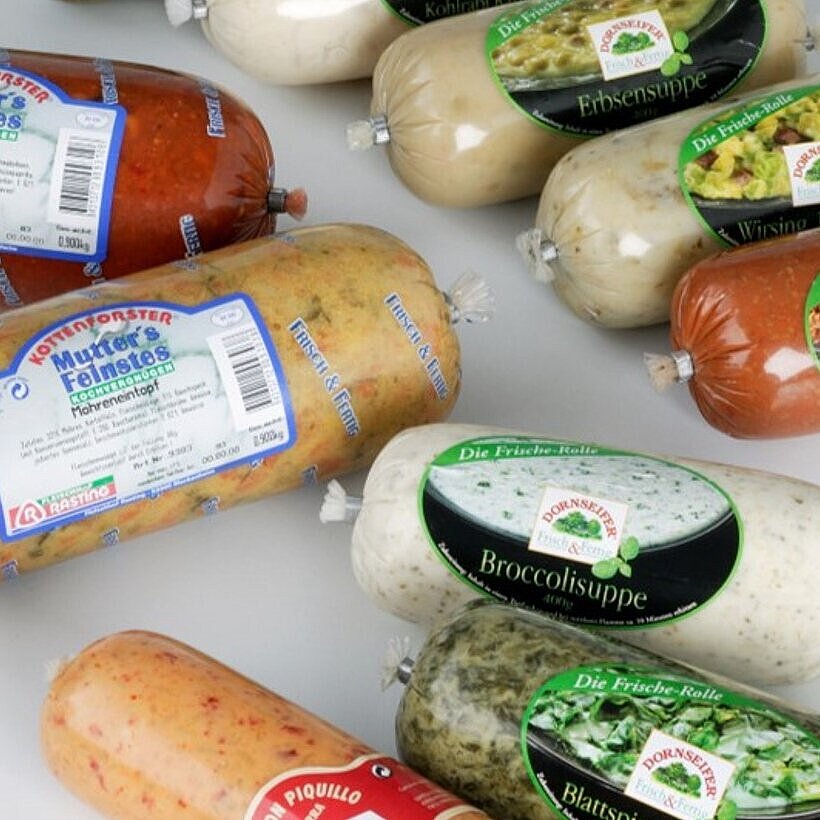
In March 2026, Poly-clip System presented its clip-pak® concept specifically for gastronomy, catering and institutional kitchens. The product is filled into a flexible film or synthetic tube, after which an automatic double clipper such as the FCA 80, FCA 120 or FCA 160 closes and separates each portion. This also works for hot, liquid or chunky products.
For central kitchens and caterers, four features are particularly relevant:
- Flexible portions: the portion size is set by the dosing and the position of the clip, not by a fixed tray. Switching between a retail portion and a bulk pack requires no new trays or moulds.
- Less manual work: after closing, the FCHL clip-and-hang machine automatically attaches a loop and hangs the product. With the ASL-R, a robotic system from Poly-clip, the products are then loaded automatically onto process trolleys.
- Hygiene and shelf life: the leak-proof, closed pack limits the risk of contamination and supports HACCP. Filled cold and pasteurised in the pack, soups and sauces keep for 6 to 10 weeks at 7 °C.
- Lower cost per portion: according to Poly-clip System, producing in larger pack units lowers the cost per portion and simplifies planning.
After clipping comes the end of line. Buhmann Pac Solutions supplies trays, boxes and robotics for this, so that the product stays in one controlled flow from the line to the pallet.
What does this mean for producers?
Central kitchens and caterers that want to grow sooner or later hit the same limit: more recipes and formats mean more changeovers, more manual work and more room for error. A packaging concept that can adjust portions flexibly without new packaging materials removes a large part of that complexity.
For those already using clipping machines for sausage, clip-pak® for pumpable products can also give the same machines a second application. The same clipping technique is used, so the investment is often smaller than expected.
The best first step is a product test with your own recipes and portion sizes. Measure not only capacity, but also the time per format change, the number of manual handling steps, the closure quality and the shelf life after heat treatment.
Would you like to find out how your central kitchen or catering production can portion and pack more flexibly? SysmaTec will gladly help you define the right Poly-clip System and Buhmann configuration for your products and volumes.
Sources
- Forbes België: Hoe Foodmaker de markt voor gezonde kant-en-klaarmaaltijden wil veroveren
- RetailDetail: Sligro Food Group, eerste helft 2026
- Poly-clip System: Efficiently packed – soups, sauces, and convenience products in clip-pak®
- Packaging Strategies: Poly-clip System launches clip-pak® for pasty convenience products
- Poly-clip System: clip-pak®
- SysmaTec: Convenience products