

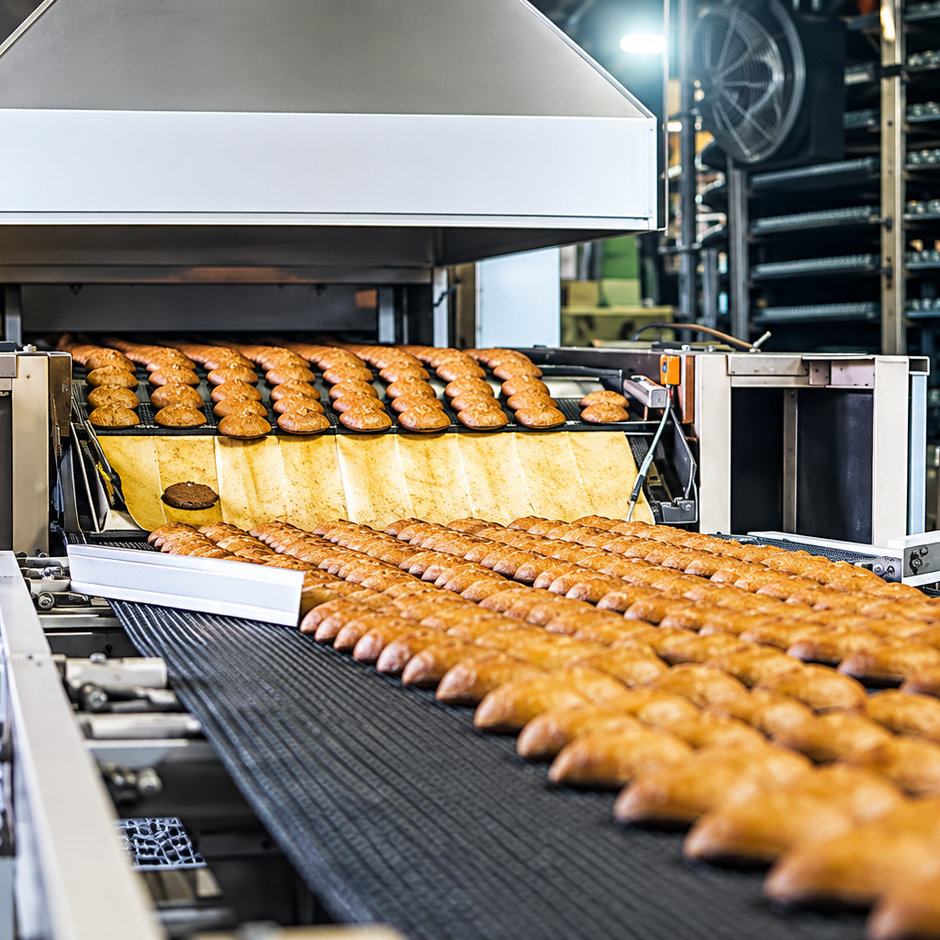
Why is plant-based protein so hard to fill and pack?
Why is plant-based protein so hard to fill and pack? A vegetarian sausage, snack or other protein-rich preparation can look perfect on paper. In production, the real challenge only starts afterwards: how do you neatly fill a mass with a different structure, how do you keep the weight consistent, and how do you close the product hygienically and efficiently?
That's precisely why alternative proteins are increasingly becoming a process question. It's not just the recipe that counts. The combination of filling, forming, packaging and shelf life also determines whether a product is ready for a larger market.
The market is growing, but consumers remain critical
Alternative proteins cover more than just plant-based meat substitutes. They also include ingredients from fermentation, algae, fungi and other new protein sources. Even so, plant-based products remain the most visible category in stores today.
Consumers expect no compromise. Taste, bite, appearance, nutritional value and price all have to be right. ProVeg points out that consumers are showing more interest in legumes and less heavily processed products, while disappointing taste and texture remain important barriers. Research from GFI Europe also shows that willingness to try new protein products is strongly linked to trust and a pleasant user experience.
Meanwhile, the European Commission is looking not only at consumption, but also at the resilience of the protein chain. In its Protein Action Plan, the Commission wants to strengthen European production of plant-based proteins, reduce dependence on imports, and improve processing and infrastructure across the value chain. For manufacturers, this means efficiency and flexibility are becoming more important, including on the production floor.
A recipe is only scalable once the process is stable
Plant-based masses don't always behave like a classic meat filling. Viscosity, fibre structure, moisture binding and sensitivity to pressure can vary widely by recipe. Overly aggressive handling can damage the structure. An unstable dosing process, in turn, leads to variation in weight, shape and portioning.
That's where the filling machine comes in. Risco develops systems for, among others, meat, fish, pet food and plant-based products. The technology is aimed at precise processing and includes vacuum fillers, portioning systems and solutions for sausage products. For alternative proteins, this means the filling can be controlled and repeatably moved to the next step, with attention to product structure and process continuity.
In practice, a good line analysis doesn't start with the machine catalogue, but with the product:
- Is the mass homogeneous, or does it contain visible pieces?
- What pressure and speed are needed to preserve the desired structure?
- Does the product need to be portioned, filled as a single piece, or fed into a casing?
- How does the product change during cooking, pasteurisation or cooling?
These questions determine which Risco configuration and which link to the packaging step make the most technical sense.
From filling to clipping: one controlled product flow
After filling comes closing. Poly-clip System offers clip technology and clip-pak® solutions for this. With clip-pak®, the product is filled into tubular packaging and closed with a clip at both ends. This makes the solution suitable for liquid, pasty and viscous products, including tofu and other plant-based preparations.
For manufacturers of alternative proteins, three properties in particular are relevant:
- Flexibility: the same basic principles can be applied to different recipes, calibres and product formats.
- Product safety: the right clip and packaging choice helps seal the product against outside influences. For certain combinations of film, casing and R-ID clips, Poly-clip System describes a bacteria-tight seal.
- Efficient use of materials: the product is formed and packaged in a single process step. According to Poly-clip System, clip-pak® can therefore use less packaging material and transport volume than various classic packaging formats.
Poly-clip System also refers to independent analyses by Circular Analytics, which calculated a lower CO₂ footprint for clip packaging than for comparable trays in specific applications. Such results depend on the application and materials involved, but they do show why packaging is increasingly becoming part of product design, rather than just a final step afterwards.
What does this mean for manufacturers?
The combination of Risco for filling and Poly-clip System for clipping offers a practical route from recipe to reproducible end product. The added value lies not in two separate machines, but in how they're aligned: product properties, filling pressure, format, packaging material, closure and post-treatment all need to work together.
For a start-up, this can help scale a new product in a controlled way. For an established food manufacturer, it can be a way to add alternative proteins to an existing production environment, without having to build an entirely separate packaging logic for every new product.
The best first step, therefore, is a product test with the real recipe. Measure not only speed, but also fill weight, product structure, seal quality, material consumption and behaviour after the planned thermal treatment. That will make clear which solution works technically and is economically sound.
Want to explore how your plant-based or alternative protein product can be filled and clipped? Sysmatec is happy to help you determine the right Risco and Poly-clip System configuration for your product and production volume.
Sources
- Poly-clip System targets alternative proteins as a strategic growth market
- Risco: Food processing solutions
- Poly-clip System: Vegan & Meat Substitute
- Poly-clip System: clip-pak®
- ProVeg International: 2025 food and drink trends affecting alternative proteins
- GFI Europe: European consumer insights on the alternative protein sector
- European Commission: Reducing the plant protein deficit of the European Union
- European Parliament Research Service: Alternative protein sources for food and feed